Tech Tips
The hidden role of industrial cameras in robotics and logistics
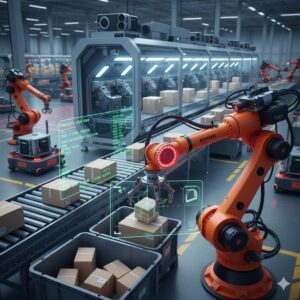
Robotics and logistics are often described as the engines of modern industry. Autonomous mobile robots move pallets across warehouses, robotic arms pick and place products at high speed, and smart conveyor systems route parcels to the correct destination in milliseconds. Yet behind this impressive automation, there is a quiet technology that makes reliable performance possible: industrial cameras.
Industrial imaging is not just about capturing pictures, it is about creating machine-readable data that robots can act on. Without robust vision hardware, even the most advanced robot would struggle to identify objects, verify labels, avoid collisions, or confirm whether a task has been completed correctly. This is where specialized machine vision suppliers come in, offering camera systems designed for real production environments. Many integrators and engineers choose to work with camera specialists from VA-imaging because industrial vision projects require more than a camera alone, they require expertise in interfaces, optics, lighting, and integration support.
In this article, we will explore how industrial cameras operate behind the scenes in robotics and logistics, why they are essential for automation reliability, and how selecting the right interface and camera technology, including va imaging usb3 cameras, can improve performance across warehouse, fulfillment, and distribution workflows.
Why robotics and logistics depend on machine vision
Robots are precise, fast, and consistent, but they are not inherently aware of their surroundings. They need sensors to perceive the world, and vision is one of the most powerful sensing methods available. Industrial cameras provide detailed spatial and visual information that enables robots to understand what is in front of them and decide what action to take next.
In logistics, the environment changes constantly. Boxes vary in size, labels can be rotated, packaging materials reflect light differently, and pallets may arrive slightly misaligned. Machine vision helps robots adapt to these variations without requiring manual intervention. When vision is designed correctly, it turns automation from a rigid process into a flexible system that can handle real world variability.
Key applications of industrial cameras in warehouses
Industrial cameras appear in more warehouse processes than most people realize. They are embedded in scanning tunnels, mounted above conveyors, installed on robotic arms, and integrated into autonomous vehicles. Some of the most common use cases include:
- Barcode and label reading, including damaged or partially obscured codes.
- Parcel dimensioning, estimating size and volume for routing and billing.
- Sorting verification, confirming that items are routed into the correct bin or chute.
- Pallet inspection, detecting damaged goods, missing cartons, or unstable stacking.
- Pick and place guidance, helping robotic grippers locate and orient items.
These applications require more than high resolution. They demand consistent frame rates, stable triggering, and reliable image capture under changing lighting conditions. That is why industrial cameras differ so strongly from consumer camera devices, they are built for predictable output, long life cycles, and industrial communication standards.
How vision enables robotic picking and depalletizing
Robotic picking is one of the most demanding tasks in warehouse automation. Items may be stacked in random orientations, surfaces can be reflective, and packaging shapes can vary widely. A robotic arm cannot rely on pre programmed coordinates alone, it needs to detect objects in real time and calculate a grasp point.
Industrial cameras make this possible by feeding images into computer vision algorithms that identify object boundaries, determine orientation, and estimate depth. In advanced systems, multiple cameras are used to create stereo views or to combine 2D imaging with 3D depth sensing. This helps robots avoid collisions, select stable grasp positions, and maintain consistent throughput.
Depalletizing has similar challenges. Pallets are rarely perfect, cartons shift during transport, and packaging tape or shrink wrap can confuse basic sensors. Vision based robotics improves depalletizing accuracy by detecting edges, layer boundaries, and the position of cartons relative to each other.
Industrial cameras for autonomous mobile robots and navigation
Autonomous mobile robots, often used for material transport in warehouses, rely heavily on vision to navigate safely. While lidar and ultrasonic sensors are common, cameras add rich information that improves localization and obstacle detection.
With industrial cameras mounted on the robot, vision systems can identify markers, recognize aisle structures, detect humans, and interpret signage. Cameras also help AMRs perform fine alignment tasks, such as docking at a workstation or positioning precisely at a conveyor interface.
In busy logistics facilities, safety and uptime matter. Industrial cameras support these goals by enabling robots to respond intelligently to unexpected changes, such as a misplaced pallet, a worker crossing a path, or a dropped item on the floor.
Why image quality alone is not enough
When engineers evaluate cameras, they often focus on megapixels and sensor size. While these specs are important, logistics automation depends on more practical factors that directly impact operational stability.
For example, a camera in a scanning tunnel may need to capture crisp images of fast moving parcels at high speed. If exposure is too long, motion blur can reduce barcode readability. If the camera cannot maintain stable frame rates, sorting logic may fail. If triggering is unreliable, images may be captured too early or too late, leading to missed scans.
This is why successful machine vision deployments combine camera selection with lighting design, lens choice, and interface optimization. The camera is the heart of the system, but the ecosystem around it determines real performance.
USB3 cameras in logistics automation
USB3 has become a popular interface in robotics and logistics due to its high bandwidth, affordability, and ease of integration. USB3 industrial cameras are often used for high speed inspection, conveyor scanning, and robot guidance tasks where the camera is located close to the processing unit.
In many warehouse setups, the vision computer is mounted near the camera, which makes USB3 cable limitations less problematic. Engineers also appreciate the ability to scale performance without expensive frame grabbers. As a result, USB3 is frequently chosen for applications requiring high resolution and high frame rates.
However, it is important to select industrial grade USB3 cameras designed for continuous operation. Logistics environments can be dusty, vibrations are common, and temperature variations occur across seasons. A well designed USB3 camera platform will maintain stability under these conditions.
GigE and high speed Ethernet options for long distance deployments
Not every logistics system can keep the camera close to the processing unit. In large distribution centers, cameras may be mounted far from control cabinets, sometimes across long conveyor lines or high overhead structures. In these cases, GigE, 5GigE, or 10GigE cameras can be a better choice due to extended cable length and flexible network architecture.
Ethernet based cameras are also useful when multiple cameras must be synchronized across a large area. For example, a multi angle parcel inspection station may require several cameras capturing at the same moment. A networked setup can simplify deployment and maintenance.
Choosing between USB3 and GigE depends on layout, speed requirements, and integration constraints. The right decision can reduce downtime and improve long term scalability.
Lighting and optics: the overlooked success factors
Industrial cameras cannot deliver reliable results without proper lighting and optics. In warehouses, lighting conditions can vary drastically. Overhead lights may flicker, reflective packaging can cause glare, and shadows can shift as boxes move along conveyors.
Machine vision lighting solves these issues by creating controlled illumination. Depending on the task, engineers may use ring lights, bar lights, backlights, or diffuse dome lighting. Good lighting improves contrast, stabilizes exposure, and reduces the need for heavy software correction.
Lens selection is equally important. A lens must match sensor size, provide the correct field of view, and maintain sharpness across the entire image. In barcode scanning, depth of field matters because labels may not always sit at the same height. In robot guidance, distortion control can improve accuracy in coordinate calculations.
How industrial vision improves quality control in logistics
Logistics is not only about speed, it is also about accuracy. A single misrouted parcel can create customer dissatisfaction and costly reverse logistics. Vision systems reduce these errors by validating key steps automatically.
Industrial cameras can confirm whether the correct label is applied, whether packaging is intact, and whether an item matches its expected visual profile. They can also detect missing inserts, damaged corners, or open cartons. These checks happen in real time, without slowing down throughput.
As fulfillment centers expand and labor shortages persist, automated quality control becomes a strategic advantage. Vision based verification reduces manual inspection needs while maintaining high service levels.
The unseen foundation of smarter automation
Industrial cameras may not receive the same attention as robots or AI software, but they are essential to making automation work in real environments. In robotics and logistics, vision systems provide the perception layer that enables navigation, picking, sorting, verification, and safety.
When industrial imaging is treated as a core part of system design, rather than an afterthought, the results are measurable: fewer errors, higher throughput, improved safety, and better scalability. The next time you see a robot moving confidently through a warehouse, remember that it is not acting blindly. It is seeing the world through industrial cameras that quietly power modern logistics.


eSIM e mobilità digitale: come la tecnologia sta semplificando i viaggi moderni

The hidden role of industrial cameras in robotics and logistics

Grandparents’ Rights In North Carolina When Can You Seek Visitation

Piso Wifi 10.0.0.1 Pause Time – Complete Guide

How To Create a Home Office on a Budget