Real Estate
A Practical 2026 Checklist for Buying a Lake-Adjacent Home
Key Takeaways
- A lake view does not automatically include legal shoreline or water access.
- Ownership costs can include HOA fees, insurance, drainage work, docks, retaining walls, and exterior maintenance.
- Flood exposure, emergency access, permits, and community restrictions should be reviewed before removing contingencies.
- Waterfront and inland homes can both be strong choices, depending on budget, privacy preferences, and daily routine.
Table of Contents
- Understand what “lake-adjacent” really means
- Build a complete ownership budget
- Verify access, boundaries, and improvements
- Review water, drainage, and emergency risks
- Match inspections to the property
- Read the HOA and community rules carefully
- Compare waterfront and inland options
- Confirm insurance and closing details
- Final Buying Checklist
Buying near a lake can mean waking up to water views, easier access to boating, and a lifestyle that feels distinct from a typical suburban purchase. It can also mean added questions about access rights, drainage, community rules, shoreline upkeep, and insurance. A smart purchase starts by separating the features that look appealing in a listing from the rights, responsibilities, and long-term costs that come with the property.
For buyers comparing private-lake living with surrounding Inland Empire neighborhoods, Canyon Lake Riverside CA real estate expert Kreg McCoy provides local real estate guidance for Canyon Lake, Riverside, and nearby Riverside County communities. Kreg McCoy’s website covers waterfront homes, inland options, gated-community considerations, local lifestyle features, and neighborhood comparisons, making it a useful starting point for buyers who need to evaluate more than square footage and views.
Understand What “Lake-Adjacent” Really Means
Lake-adjacent homes are not all alike. A direct waterfront property may have shoreline frontage, a dock, or immediate access to the water. A lake-view home may overlook the water without providing any right to reach it. A near-lake home may be a short walk or drive from a launch area, while an inland home may still offer community amenities such as parks, trails, or boat storage.
That distinction can affect value and usefulness. Two similarly sized homes may have very different appeal if one includes a permitted dock and the other has only a distant view. Treat listing language as a starting point, not proof of ownership rights or permitted improvements.
Build a Complete Ownership Budget
Before focusing on the purchase price, estimate the full monthly and annual cost of ownership. Include the mortgage payment, property taxes, HOA dues, insurance, utilities, landscaping, pest service, and reserves for repairs. Larger lots, extensive decks, pools, boat lifts, retaining walls, and shoreline structures can entail expenses not found in a standard suburban home.
Simple Monthly Cost Worksheet
- Known costs: Mortgage estimate, taxes, HOA dues, and insurance quote.
- Estimated cost: Utilities, landscaping, dock care, exterior repairs, and pest control.
- Needs verification: Special assessments, flood coverage, private-road costs, and planned capital projects.
Verify Access, Boundaries, and Improvements
Confirm what the seller owns, what is shared, and what is nearby. Review title information for easements, access rights, shared-driveway obligations, and shoreline responsibilities. Ask whether docks, boat lifts, ramps, fences, retaining walls, and outdoor electrical equipment are included in the sale and whether they were properly approved.
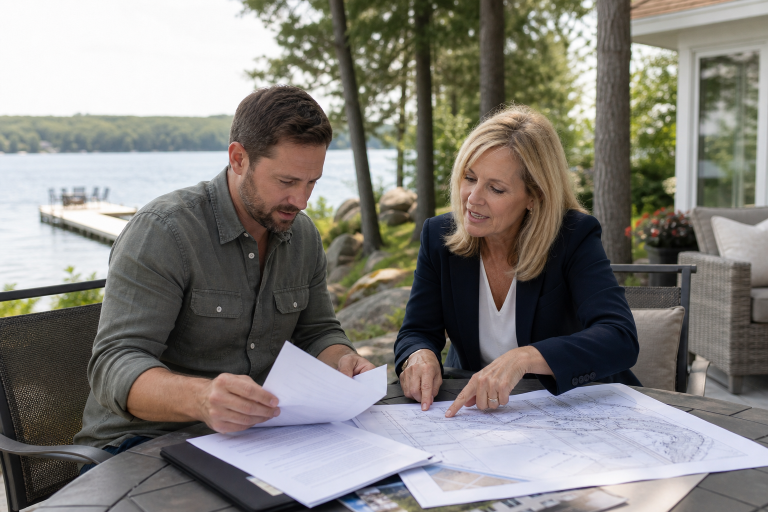
A current survey can be especially helpful when structures sit close to lot lines or water edges. It may clarify where a fence, driveway, dock, or retaining wall is located and reduce the chance of inheriting a boundary dispute. Also, ask who maintains private roads, shared shoreline areas, gates, and common facilities.
Review Water, Drainage, and Emergency Risks
A home does not need to sit directly on the shoreline to have water-related risks. During tours, look for standing water, erosion, uneven grading, stained walls, damaged drains, sloped driveways, or signs that runoff collects near the foundation. Ask the seller about past flooding, water intrusion, mold, drainage repairs, and insurance claims.
Buyers should request insurance quotes early because standard homeowners policies commonly do not cover flood damage. The California Department of Insurance offers flood insurance guidance for homeowners that explains why reviewing coverage before closing matters. For homes near a reservoir or dam, also review emergency planning, access routes, and relevant California dam safety resources.
Match Inspections to the Property
A standard home inspection is important, but it may not fully evaluate every lake-related feature. Inspect the roof, foundation, crawl space, drainage, decks, stairs, railings, retaining walls, patios, and outdoor electrical systems. Depending on the property, bring in specialists for docks, seawalls, slopes, septic systems, wells, large trees, or structural concerns.
Compare inspection findings with seller disclosures and permit records. Request invoices, maintenance logs, warranties, and reports for major repairs. A documented history does not eliminate risk, but it helps show whether a feature has been consistently maintained or merely patched before listing.
Read HOA and Community Rules Carefully
In gated and amenity-rich communities, rules can shape daily life as much as the home itself. Review the HOA budget, governing documents, meeting minutes, reserve funding, transfer fees, and any pending special assessments. Check restrictions involving boats, trailers, rentals, guests, exterior paint, fences, landscaping, and construction work.
Confirm whether lake access requires membership, registration, separate fees, or approval. Ask whether the property has unresolved rule violations and who is responsible for maintaining launch areas, parks, roads, docks, and common shoreline features.
Compare Waterfront and Inland Options
- Waterfront homes: Often offer faster access to water, views, and a stronger recreation-focused appeal. They may also involve more shoreline, dock, and weather-related maintenance.
- Inland homes: May have lower water-specific upkeep and more privacy from shoreline activity. They can still provide access to community amenities without direct waterfront responsibilities.
- Resale considerations: Waterfront homes may appeal to a lifestyle-focused buyer, while inland homes can attract buyers with a broader range of budgets and maintenance preferences.
Confirm Insurance and Closing Details
Request written homeowners insurance terms during the inspection period, not just before closing. Ask about separate flood, earthquake, watercraft, dock, liability, and detached-structure coverage. Compare deductibles, exclusions, policy limits, and lender requirements rather than choosing solely by premium.
Final Buying Checklist
- ☐ Estimate the complete monthly ownership cost.
- ☐ Verify water access, boundaries, easements, and shared responsibilities.
- ☐ Review HOA rules, reserves, assessments, and open violations.
- ☐ Check flood, drainage, dam, and emergency-access concerns.
- ☐ Inspect the home and all relevant outdoor structures.
- ☐ Review permits, disclosures, repair records, and insurance terms.
A lake-adjacent home can be an excellent fit when its lifestyle benefits match the buyer’s budget, maintenance tolerance, and long-term plans. The best choice is not necessarily the house closest to the water. It is the property where access, condition, costs, and community rules are all clear before closing.


How Nevada Rules Shape a Personal Injury Claim After a Crash

A Yard-Watering Plan: Match Soil, Plants, and Sprinklers Before You Turn On the Timer

A Practical Coastal Home Buying Checklist in Panama City, Florida

Piso Wifi 10.0.0.1 Pause Time – Complete Guide

High-Risk Threats Targeting Banks and How to Mitigate Them
