Tech News
Choosing the Right Trailer for Your Transport Needs
Table of Contents
- Assess Your Hauling Requirements
- Determine the Appropriate Size and Weight Capacity
- Choose Between Open and Enclosed Trailers
- Select the Right Axle Configuration
- Consider Trailer Materials and Build Quality
- Evaluate Safety Features
- Ensure Compatibility with Your Tow Vehicle
- Factor in Terrain and Driving Conditions
- Conclusion
Efficiently transporting goods, equipment, or vehicles begins with selecting the right trailer for the job. With so many options, understanding the most important factors can ensure safety, maximize efficiency, and help you control costs. The right choice will depend on a careful evaluation of your specific requirements and the intended application, which is why insights on material handling trailers play a critical role for many industries. Whether your focus is on robust construction needs or secure delivery for valuable cargo, the foundation is always a well-chosen trailer.
Many operations depend on having the right size, configuration, and build quality to avoid delays, reduce risks, and keep transportation expenses in check. From open to enclosed builds to single- to tandem-axle options, every transport scenario has an ideal solution. Investing time to evaluate trailers that fit your workload means better long-term value and fewer headaches on the road. Matching your trailer to your tow vehicle, considering weather resistance, and focusing on safety features are all central themes in finding success with your next trailer purchase.
Assess Your Hauling Requirements
The first step in selecting a trailer is identifying exactly what you need to transport. Are you carrying lumber and construction supplies? Do you need to move recreational vehicles, cars, or large equipment? If you work in landscaping, a compact flatbed trailer may suffice. For automotive businesses or those hauling sensitive goods, an enclosed trailer might be the preferred option for extra security and weather protection. Determining your primary use ensures the trailer you purchase is fit for both your current and future jobs.
Determine the Appropriate Size and Weight Capacity
The safest and most efficient trailers align with the dimensions and weight limits required for your intended cargo. An undersized trailer forces you to make multiple trips, while a much larger one can strain your towing vehicle or lead to unnecessary fuel costs. For small businesses, common trailer sizes include 5×8 to 6×12 feet. Larger trailers, like 7×16 or 8.5×20 feet, are favored by contractors or heavy-duty users. Always pay attention to the trailer’s Gross Vehicle Weight Rating (GVWR), ensuring it is within your tow vehicle’s capabilities. This compatibility is not only necessary by law but also a safeguard against mechanical damage and accidents.
Choose Between Open and Enclosed Trailers
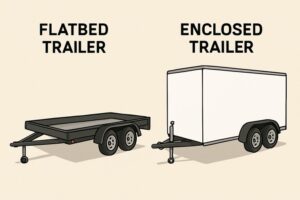
Open trailers offer ease of loading, lower upfront cost, and lighter weight, making them ideal for equipment or bulk materials that are unaffected by weather. Enclosed trailers, on the other hand, offer added protection against theft and environmental exposure, making them ideal for transporting valuable or weather-sensitive items. Your decision should be based on what you are hauling, your security concerns, and the weather conditions you will most frequently face.
Select the Right Axle Configuration
Axle choice affects both the types of loads you can haul and how smoothly your trailer performs. Single-axle trailers work well for light loads and urban trips. Tandem-axle options deliver better stability, distribute weight more evenly, and boost durability for heavier equipment. The suspension system matters too: leaf-spring designs are affordable and easy to service, while torsion systems offer a quieter ride and absorb road shock more effectively.
Consider Trailer Materials and Build Quality
Materials play a significant role in trailer selection. Steel trailers offer strong frames at a lower upfront cost, though they require consistent rust prevention. Aluminum trailers are lighter and more corrosion-resistant, leading to lower maintenance and a higher resale value, especially when you use the trailer year-round or on salted winter roads. Build quality should never be overlooked, as structural integrity determines how your trailer will withstand daily wear and unexpected stresses.
Evaluate Safety Features
The right safety features protect both driver and cargo. Ensure your trailer is equipped with reliable lighting, electric brakes, and secure chains. Modern safety features also include anti-sway controls or breakaway systems, which are vital for long-distance and heavy-haul applications. Equally important is adherence to state and local regulations and practicing regular trailer maintenance for continued safety on the road.
Ensure Compatibility with Your Tow Vehicle
Matching your trailer to your tow vehicle is vital. The vehicle must be capable of handling the loaded weight of the trailer. Check the towing capacity, verify the correct hitch rating, and confirm tongue weight specifications for balanced, stable transport. Poor matches can lead to handling problems, unsafe operation, and even legal issues. Always follow the vehicle manufacturer’s guidelines when considering any trailer purchase.
Factor in Terrain and Driving Conditions
The terrain you regularly encounter will guide your selection of trailer enhancements. Rugged or unpaved roads require better suspension and reinforced axles. In areas prone to rain, snow, or ice, prioritize corrosion-resistant materials and specialized tires for traction. Accessories like weatherproof lighting, mud flaps, or lockboxes provide extra security and functionality suited to your region’s needs. Environmental awareness ensures both vehicle and cargo safety, no matter where the road takes you.
Considering each of these critical aspects will help you select a trailer that is efficient, reliable, and safe for your transport needs. This thoughtful approach guarantees long-term satisfaction and protects your investment on every haul.
Conclusion
In conclusion, choosing the right trailer involves a careful evaluation of your hauling needs, cargo type, size requirements, and towing capacity. By considering factors such as trailer type, axle configuration, materials, safety features, and environmental conditions, you can select a model that is both reliable and efficient for your specific operations. Ensuring compatibility with your tow vehicle and accounting for terrain and climate further enhances safety and performance. Prioritizing quality construction and regular maintenance protects your investment and minimizes the risk of breakdowns or accidents. Ultimately, a well-chosen trailer delivers long-term value, dependable service, and peace of mind for all your hauling tasks.


How Nevada Rules Shape a Personal Injury Claim After a Crash

A Yard-Watering Plan: Match Soil, Plants, and Sprinklers Before You Turn On the Timer

A Practical Coastal Home Buying Checklist in Panama City, Florida

Piso Wifi 10.0.0.1 Pause Time – Complete Guide

High-Risk Threats Targeting Banks and How to Mitigate Them
