Tech Tips
The Technology That Makes Bitcoin Payments Possible
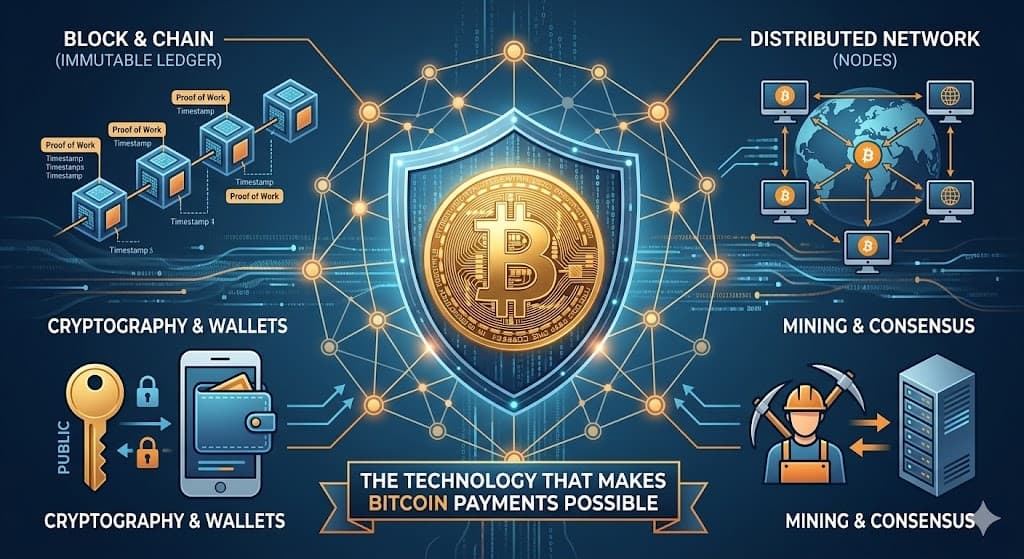
What is a bitcoin, and how does it work? Is it another bank?
Most people have heard of Bitcoin. But fewer understand that when someone uses it to make a payment, no bank servers are processing the request. No financial institution is approving the transfer. It doesn’t need business hours to wait for.
Why???
To understand this, you need to look at the technology working underneath it.
When you choose to pay with bitcoin, you are not sending money through a bank. You are broadcasting a transaction directly to a global network of computers that verify, record, and permanently store it without any central authority involved. Four things make this possible:
- Blockchain
- Nodes: A network of independent computers
- Cryptographic key pairs
- Mining: a verification process.
How a Bitcoin Transaction Works
You Send Bitcoin → Private Key Signs & Approves It → Transaction Broadcasts to the Network → Nodes Verify It → Enters the Memory Pool → Miner Picks It Up → Packed Into a Block → Puzzle Solved & Block Sealed → Added to the Blockchain → Payment Confirmed & Permanent
What Is A Blockchain? How Does It Work?
The blockchain is a ledger nobody owns, but everyone can read!
Think of the blockchain as a shared notebook that records every Bitcoin transaction ever made. Unlike a bank’s private database, this notebook is not stored in a single location. Thousands of identical copies exist simultaneously across computers worldwide.
Transactions are grouped into files called blocks. Each block contains a collection of recent transactions and, once full, is sealed with a unique cryptographic hash. That hash is then embedded into the next block, linking them together in a permanent chronological chain.
This structure has one important consequence. Altering any historical transaction would change the hash of that block, which would break every block that follows it. The rest of the network would immediately reject the altered version. In practice, the record is permanent.
“Nodes”: The Computers That Keep the Network Honest
A node is simply a computer running Bitcoin software and holding a full copy of the blockchain. There are thousands of them operating independently across the globe. Nobody owns them in particular. This system is not answerable to any single institution.
When a transaction is broadcast to the network, nodes check it against the existing blockchain to confirm that the sender actually owns the funds they are trying to move. If the transaction is valid, nodes accept it. If something does not add up, the transaction is rejected before it goes any further.
Because every node holds an identical copy of the ledger. There is no central point of failure. Shutting down one computer, or even thousands of them, does not affect the network. The remaining nodes continue to verify and record transactions without interruption.
“Private Keys”: How Ownership Is Proved Without a Bank
When someone holds Bitcoin, what they actually hold is a private key. This is a long string of numbers and letters generated mathematically and known only to the owner. A practical comparison would be a password, though far more complex and impossible to guess.
Every time a transaction is initiated, the private key generates a unique digital signature for that specific transfer. This signature does the job of proving two things simultaneously: that the transaction was authorised by the rightful owner, and that the details of the transaction have not been changed since it was signed.
Once a signed transaction is broadcast to the network, its contents are locked. No third party and no intermediate system can alter what was agreed.
“Mining”: How Transactions Are Confirmed and Closed
Signing a transaction and broadcasting it to the network is not the final step. Before it becomes a permanent part of the blockchain, it needs to be confirmed through a process called mining.
Miners are computers competing to solve a complex mathematical puzzle. The puzzle requires a huge effort to solve. But it can be verified only when a solution is found. The first miner to solve it earns the right to add the next block of transactions to the chain and receives a small Bitcoin reward for doing so.
This competitive process serves a specific purpose. It makes adding fraudulent transactions extraordinarily expensive in terms of computing power and energy. By the time any bad actor could attempt to manipulate the chain, the network has already moved several blocks ahead.
Confirmation typically takes around ten minutes per block. A transaction is generally considered fully settled after six blocks have been added on top of it, which takes roughly one hour.
“The Network”: Why Bitcoin Transactions Are Difficult to Compromise
Every Bitcoin transaction is recorded openly and can be viewed by anyone through a blockchain explorer. Every node on the network holds its own copy of that record and updates automatically each time a new block is confirmed.
This is what makes the data so hard to tamper with. If someone tried to alter a transaction on one node, every other node would instantly compare hashes and reject the changed version. The record does not sit in one place waiting to be targeted. It exists across thousands of computers simultaneously.
According to a Bitcoin study paper, as of May 2026, the Bitcoin network was processing transactions at a hashing rate of approximately 850 exahashes per second. That is 850 quintillion calculations every second. By the time any attacker made a move, the network would already be several blocks ahead.
Traditional Bank Payment vs Bitcoin Payment
| Feature | Traditional Bank Payment | Bitcoin Payment |
| Controlling Authority | Central bank or institution | Decentralised global network |
| Operating Hours | Business hours, 5 days a week | Every hour of every day |
| Settlement Time | One to three business days | Roughly ten to sixty minutes |
| Transaction Record | Private internal database | Publicly visible blockchain |
| Third Party Required | Yes, always | No |
| Supply Control | Determined by central banks | Fixed at 21 million by protocol |
| Reversibility | Possible through the bank | Irreversible once confirmed |
Both systems move money differently. Banks depend on multiple third-party services to process transactions. Bitcoin operates through its own independent network without relying on any outside association.
Summary
The moment a payment is initiated, the private key signs it and the signed transaction is broadcast to the network. Nodes pick it up immediately and run their verification checks. Valid transactions enter a queue called the memory pool, where they wait to be selected by a miner. Once a miner packages the transaction into a block and solves the required puzzle, the block is broadcast back to the network. Nodes confirm it, add it to their copies of the blockchain, and the payment becomes part of the permanent record.
This entire process involves no phone calls, no forms, no business hours, and no institution deciding whether the transfer should be allowed.


How Nevada Rules Shape a Personal Injury Claim After a Crash

A Yard-Watering Plan: Match Soil, Plants, and Sprinklers Before You Turn On the Timer

A Practical Coastal Home Buying Checklist in Panama City, Florida

Piso Wifi 10.0.0.1 Pause Time – Complete Guide

High-Risk Threats Targeting Banks and How to Mitigate Them
